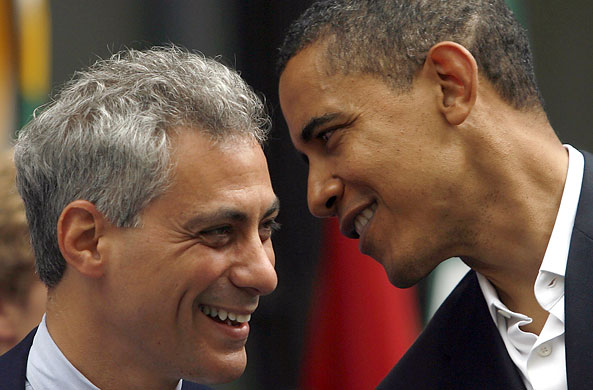
President-elect Barack Obama has turned to Representative Rahm Emanuel of Illinois, the fourth-ranking House Democrat and a close friend from Chicago, for a chief of staff, and John Podesta, the former Clinton White House chief of staff, to lead his transition team.
In turning to Emanuel and Podesta, Obama sought out two veterans of President Bill Clinton's administration, known for their deep Washington experience, savvy and no-holds-barred approach to politics. Neither is considered a practitioner of the "new politics" that Obama promised on the campaign trail to bring Republicans and Democrats together, suggesting that the cool and conciliatory new president is determined to demonstrate toughness from the beginning.
Obama stayed largely out of sight on Wednesday as Democrats counted their gains and Republicans stewed over what went wrong. The scope of his success underscored the nation's discontent with George W. Bush's presidency.
The election proved so invigorating to the American public that turnout climbed to its highest rate in 44 years. Although experts differed in their projections as provisional and absentee ballots are counted, Michael McDonald, a voting expert at George Mason University, estimated that 133.3 million people had voted, eclipsing the 123 million who participated four years ago. That amounted to 62.6 percent of all eligible voters, just shy of the 62.8 percent in 1964, when President Lyndon B. Johnson was running against Senator Barry Goldwater.
With the election now behind them, the Bush and Obama teams began the delicate 77-day transition period. The General Services Administration turned over 120,000 square feet, or 11,000 square meters, of office space in downtown Washington to the Obama transition team, and select Obama advisers were due to be given interim security clearances.
Obama and Vice President-elect Joseph Biden Jr. will receive briefings on Thursday from Mike McConnell, the director of national intelligence, and thereafter each morning by a pair of Central Intelligence Agency officials. Obama was given brief updates during the campaign, but aides said the sessions now would resemble the presidential daily briefing presented to Bush each morning.
Beyond choosing staff members, Obama must decide how active he intends to be in asserting leadership during the transition. Obama has conferred with congressional leaders about passing a $100 billion economic stimulus package in a lame-duck session the week of Nov. 17 to pay for public works projects, aid to cities and states and unemployment, food stamp and heating benefits.
But congressional aides said that if Obama could not win agreement from Bush and Senate Republicans, they might scale the package back to about $60 billion to pay for unemployment and other benefits, then come back in January with a broader economic spending plan.
Obama talked regularly with Treasury Secretary Henry Paulson Jr. about the financial crisis during the campaign, but it remained unclear how closely he wants to coordinate action during the transition. The situation is so dire, it may demand immediate action from a newly elected president, but Obama advisers are wary of taking ownership over decisions made by Bush.
On his first morning as president-elect, Obama did something he rarely did during the last 22 months: he woke up at home in Chicago and had breakfast with his wife, Michelle, and his two young daughters, Malia and Sasha. He spent the day out of view, making thank-you calls and meeting with transition advisers, a decision aides said was intended to draw a line between the campaign and the coming task of governing. They said he canceled fireworks at the Tuesday night celebration to underscore the seriousness of the moment.
Washington was abuzz with speculation - some of it informed, much of it guesswork - over who would join the new administration. Democrats close to the Obama team said they believe the likeliest choices for Treasury secretary would be Lawrence Summers, who held the post in the Clinton administration, and Timothy Geithner, president of the Federal Reserve Bank of New York.
In the national security arena, much depends on whether Obama decides to ask Defense Secretary Robert Gates to stay to demonstrate bipartisanship. If Obama decides against it, or Gates turns him down, Democrats see former Deputy Defense Secretary John Hamre and former Navy Secretary Richard Danzig as two candidates for the Pentagon.
Without Gates, Obama might want to tap a Republican for the State Department, including perhaps Senators Richard Lugar of Indiana or Chuck Hagel of Nebraska, advisers said. If Gates stays, some Democrats said Senator John Kerry, the Democratic nominee who gave Obama the platform at the 2004 convention that vaulted him to national fame, is a leading choice to be secretary of state.